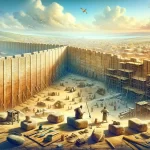
Faithfulness Under Foreign Kings
One Sentence Memory Line
Daniel reveals how God sovereignly rules over earthly kingdoms while calling His people to faithful endurance in exile.
Historical Setting
The Book of Daniel unfolds during the Babylonian exile, beginning around 605 BC when King Nebuchadnezzar deported Jewish captives from Jerusalem. Daniel, likely a young noble, was taken into Babylon and trained in the court of a foreign empire. The narrative continues through the reigns of Babylonian and Medo-Persian rulers, including Nebuchadnezzar, Belshazzar, Darius, and Cyrus. This setting places Daniel among a displaced people navigating life under pagan authority, raising urgent questions about identity, loyalty, and worship in a hostile environment.
Canonical Placement
Daniel is located among the Major Prophets in the English Bible, following Ezekiel. In the Hebrew Bible, it appears in the Writings section rather than the Prophets, reflecting its unique blend of narrative and apocalyptic vision. This dual identity signals that Daniel functions both as a historical account and as a prophetic revelation.
Redemptive History Placement
Daniel stands at a critical moment in redemptive history when Israel is under divine discipline through exile. The Davidic kingdom appears shattered, yet Daniel reveals that God has not abandoned His covenant purposes. Instead, He is orchestrating history toward a future kingdom that cannot be shaken. The exile becomes a stage where divine sovereignty is displayed rather than diminished.
Covenant Context
The covenant backdrop includes both the Mosaic covenant, which warned of exile for disobedience, and the Abrahamic and Davidic covenants, which promised restoration and enduring kingship. Daniel lives in the tension between judgment and promise. His prayers and visions reflect confidence that God remains faithful even when His people are scattered.
Purpose of the Book
The purpose of Daniel is to encourage God’s people to remain faithful under pressure by revealing that God rules over all kingdoms and will ultimately establish His everlasting dominion. It answers a pressing question for exiles: Who is really in control when the world seems ruled by pagan power?
Central Message
The central message of Daniel is that God is sovereign over history and calls His people to steadfast faithfulness, even when obedience carries a cost.
Key Insight: The kingdoms of this world rise with noise and fall with dust, but the kingdom of God advances with quiet certainty and eternal authority.
Major Themes
Key themes include divine sovereignty, faithfulness in exile, judgment on human pride, and the coming kingdom of God. Daniel also emphasizes the contrast between earthly empires and God’s eternal reign. Another prominent theme is wisdom, as Daniel and his companions demonstrate discernment rooted in devotion to God.
Literary Genre
Daniel combines historical narrative and apocalyptic literature. Chapters 1 through 6 present court narratives, while chapters 7 through 12 contain symbolic visions. The apocalyptic sections use imagery, numbers, and symbolic beasts to reveal spiritual realities behind historical events.
Literary Structure
The book is divided into two major sections. The first section focuses on Daniel’s life in exile, while the second presents visions concerning future kingdoms and God’s ultimate victory. The structure intentionally moves from visible events to unseen realities.
Structural Outline
- Chapters 1 to 6: Historical narratives of faithfulness in exile
- Chapters 7 to 12: Apocalyptic visions of future kingdoms
Major Characters or Figures
Daniel is the central figure, accompanied by his companions Shadrach, Meshach, and Abednego. Key rulers include Nebuchadnezzar, Belshazzar, and Darius. Each character represents a response to divine authority, either submission or resistance.
Major Events
Significant events include Daniel’s refusal of royal food, the fiery furnace, Nebuchadnezzar’s humbling, the handwriting on the wall, and Daniel in the lions’ den. These accounts illustrate that obedience to God often places believers in conflict with worldly systems.
Key Verses
“He changes times and seasons; he removes kings and sets up kings; he gives wisdom to the wise and knowledge to those who have understanding.” Daniel 2:21 (ESV)
“But the saints of the Most High shall receive the kingdom and possess the kingdom forever, forever and ever.” Daniel 7:18 (ESV)
“And those who are wise shall shine like the brightness of the sky above.” Daniel 12:3 (ESV)
Christological Connection
Daniel’s vision of the “Son of Man” in chapter 7 directly points to Jesus Christ, who uses this title for Himself throughout the Gospels. The eternal kingdom described in Daniel finds its fulfillment in Christ’s reign. The faithful suffering of Daniel and his companions also foreshadows the obedience of Christ under persecution.
Biblical Theology Contribution
Daniel contributes a robust theology of God’s sovereignty over nations. It reinforces that history is not random but directed toward God’s purposes. The book also deepens understanding of resurrection and final judgment, especially in Daniel 12.
Canonical Connections
Daniel connects with Revelation through shared imagery of beasts and kingdoms. It also echoes themes from Genesis regarding God’s rule over creation and from the Psalms concerning divine kingship. The prophetic vision aligns with Isaiah’s and Jeremiah’s promises of restoration.
Doctrinal Significance
Divine sovereignty is the dominant doctrine, affirming that God governs all political and historical developments. The book also emphasizes faithful perseverance and introduces early teaching on resurrection and final judgment.
Teaching Outline for Ministry
1. Faithfulness in a Foreign Culture
2. God’s Sovereignty Over Kings
3. The Cost of Obedience
4. The Certainty of God’s Kingdom
Ministry Leadership Insight
Daniel demonstrates that leadership in hostile environments requires conviction without compromise. Ministers are not called to withdraw from culture but to engage it with discernment. Daniel does not shout for influence, yet he becomes indispensable because of his faithfulness.
Ministry and Life Application
Ministers today often function in environments that mirror exile, where cultural values conflict with biblical convictions. Daniel calls believers to live with courage, integrity, and trust in God’s sovereignty. The question is not whether pressure will come, but whether faith will endure when it does.
Common Misinterpretations or Debates
Debates often arise regarding the interpretation of Daniel’s visions, particularly the identity of the kingdoms and timelines. Some approaches overemphasize speculation while neglecting the book’s central message of faithfulness. A balanced reading prioritizes theological clarity over predictive curiosity.
Teaching Keywords
Sovereignty, exile, kingdom, faithfulness, apocalyptic, perseverance, judgment, wisdom.
Summary Paragraph
The Book of Daniel equips ministers with a steady vision in unstable times. It teaches that while kingdoms rise and fall with impressive noise, God quietly governs every moment. Daniel does not promise comfort, but it guarantees purpose. For the minister holding a Bible in one hand and navigating a complex world with the other, Daniel serves as both compass and anchor.
Sources
The Holy Bible, English Standard Version. (2001). Crossway.
Easton, M. G. (1897). Easton’s Bible Dictionary.
Vine, W. E. (1940). Vine’s Expository Dictionary of Old and New Testament Words.
Willmington, H. L. (1999). Willmington’s Guide to the Bible.
Boyce, J. P. (1887). Abstract of Systematic Theology.