Defining Theology Proper
Theology Proper is the branch of Christian theology that studies God Himself, not merely His works, but His being, character, attributes, and triune life. If Christology asks who Jesus is and Pneumatology examines the Holy Spirit, Theology Proper asks the most foundational question of all: Who is God? Every other doctrine stands or falls on this answer. If our understanding of God is distorted, everything downstream bends with it. If it is clear and biblical, the entire structure of Christian doctrine stands firm.
The term comes from the Greek word theos, meaning God, and logos, meaning word or study. In simple language, Theology Proper is the study of God’s nature and attributes as revealed in Scripture. It is not speculation about an unknown force, nor philosophical guessing about ultimate reality. It is a disciplined attempt to understand how God has revealed Himself in His Word. As Easton explains, theology concerns the knowledge of God derived from revelation rather than human imagination (Easton, 1897). Scripture is not silent about God’s nature. It begins with Him: “In the beginning, God created the heavens and the earth.” Genesis 1:1 (ESV). Before sin, before nations, before covenants, there is God.
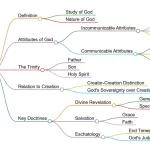
The Existence of God
The doctrine begins with the existence of God. Scripture does not argue for God as though He were on trial. It assumes Him. Psalm 14:1 declares, “The fool says in his heart, ‘There is no God.’” Psalm 14:1 (ESV). The biblical writers treat disbelief not as intellectual sophistication but as moral resistance. According to Geisler, the classical Christian understanding affirms that God’s existence is both self evident through creation and confirmed through revelation (Geisler, 1999). Romans 1:20 reinforces this: “For his invisible attributes, namely, his eternal power and divine nature, have been clearly perceived, ever since the creation of the world.” Romans 1:20 (ESV). Theology Proper therefore begins not with doubt, but with recognition.
The Attributes of God
From there, Scripture reveals God’s attributes. These are not abstract qualities added to God. They describe who He eternally is. Christian theology traditionally distinguishes between communicable and incommunicable attributes. Incommunicable attributes belong to God alone. He is eternal, self existent, unchanging, and infinite. “Before the mountains were brought forth, or ever you had formed the earth and the world, from everlasting to everlasting you are God.” Psalm 90:2 (ESV). Boyce explains that God’s immutability means He does not change in His essence or character (Boyce, 1887). This is not cold rigidity; it is covenant faithfulness. If God changed in His nature, promises would dissolve.
Communicable Attributes
Communicable attributes, by contrast, are those reflected in humanity in limited form. God is holy, just, loving, wise, and good. “God is love.” 1 John 4:8 (ESV). “Holy, holy, holy is the Lord of hosts.” Isaiah 6:3 (ESV). Vine notes that biblical holiness carries the sense of moral purity and separateness (Vine, 1940). God’s love does not cancel His holiness, nor does His justice weaken His mercy. Theology Proper insists that these attributes exist in perfect unity. God is not sometimes just and sometimes loving. He is always fully Himself.
The Trinity: One God in Three Persons
The doctrine reaches its clearest expression in the revelation of the Trinity. Christian theology affirms one God in three persons: Father, Son, and Holy Spirit. This is not three gods, nor one person wearing three masks. It is one divine essence eternally existing in three distinct persons. “Go therefore and make disciples of all nations, baptizing them in the name of the Father and of the Son and of the Holy Spirit.” Matthew 28:19 (ESV). The singular word name is joined with three persons. Willmington explains that the Trinity is not a contradiction but a revealed mystery, meaning it is beyond full human comprehension yet clearly taught in Scripture (Willmington, 1981). Theology Proper therefore guards both unity and distinction within the Godhead.
Pastoral and Ministerial Implications
Why does this matter for ministers? Because worship rises no higher than our understanding of God. A diminished view of God produces shallow preaching and thin discipleship. If God is reduced to a therapeutic assistant, reverence disappears. If He is treated only as sovereign power without covenant love, intimacy fades. Theology Proper keeps the church anchored. It reminds pastors that ministry is not built on charisma or strategy but on the unchanging character of God.
It also shapes pastoral confidence. God’s sovereignty assures us that history is not drifting. “Our God is in the heavens; he does all that he pleases.” Psalm 115:3 (ESV). At the same time, His goodness assures us that His will is never arbitrary. Torrey emphasizes that God’s attributes must be understood together, not isolated, so that sovereignty is never separated from righteousness (Torrey, 1898). In pastoral care, this balance steadies both preacher and congregation.
Theology Proper and Worship
Theology Proper ultimately leads to worship. When Moses asked to see God’s glory, the Lord declared His own name: “The Lord, the Lord, a God merciful and gracious, slow to anger, and abounding in steadfast love and faithfulness.” Exodus 34:6 (ESV). God defines Himself. Theology Proper listens. It does not invent new images of God to suit cultural pressure. It receives the revelation God has given.
In the end, Theology Proper is not a classroom exercise. It is the foundation of everything the church believes, proclaims, and lives. To know God rightly is to preach Christ faithfully, to trust providence confidently, and to worship reverently. Every sermon, every act of discipleship, every mission endeavor begins with this confession: God is who He says He is, and He has made Himself known.
References
Boyce, J. P. (1887). Abstract of systematic theology. American Baptist Publication Society.
Easton, M. G. (1897). Easton’s Bible dictionary. Thomas Nelson.
Geisler, N. L. (1999). Baker encyclopedia of Christian apologetics. Baker Books.
Torrey, R. A. (1898). What the Bible teaches. Fleming H. Revell.
Vine, W. E. (1940). Vine’s expository dictionary of New Testament words. Fleming H. Revell.
Willmington, H. L. (1981). Willmington’s guide to the Bible. Tyndale House.