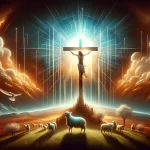
The Doctrine of Christian Incarnation Defined
The Doctrine of Christian Incarnation affirms that the eternal Son of God, the second Person of the Trinity, assumed a complete human nature without ceasing to be fully divine. The term incarnation comes from the Latin incarnatio, meaning to become flesh. John 1:14 stands at the center, “And the Word became flesh and dwelt among us” ESV. This claim presupposes John 1:1, which identifies the Word as eternally God. The incarnation therefore marks not the Son’s beginning, but His taking of humanity into personal union with Himself. Evangelical theology insists that the Son added what He was not, and He did not surrender what He eternally is. He remained consubstantial with the Father in deity, while becoming consubstantial with us in humanity. In this act God drew near in history, not by illusion, but by true embodiment.
Biblical Revelation and the Shape of the Mystery
Scripture presents the incarnation as a purposeful movement in redemptive history. Galatians 4:4 states that God sent forth His Son, born of woman, born under the law. Philippians 2:6 to 8 teaches that the One who existed in the form of God humbled Himself by taking the form of a servant and being born in human likeness. This humility describes a voluntary lowering in status and glory, not a change in divine essence. Colossians 2:9 adds that the whole fullness of deity dwells bodily in Christ, tying deity to His embodied life. Hebrews 2:14 explains that He shared in flesh and blood so that through death He might destroy the one who has the power of death. The virgin conception in Matthew 1:18 to 25 and Luke 1:26 to 35 safeguards divine initiative and authentic humanity. Hebrews 4:15 insists that He was tempted as we are, yet without sin, which anchors His solidarity and His fitness to save.
The Hypostatic Union in Systematic Clarity
The church has summarized the biblical data by speaking of the hypostatic union, the union of two natures in one person. James P. Boyce describes Christ as possessing two distinct natures, divine and human, united in one person without confusion, change, division, or separation. Boyce stresses that each nature retains its proper attributes, so the divine does not become human and the human does not become divine. This precision protects the gospel from opposite errors. If Christ is less than God, His saving work lacks infinite worth and final authority. If Christ is less than man, He cannot truly represent us, obey for us, or die for us. R. A. Torrey reinforces this balance by gathering texts that ascribe to Jesus divine names and honors, while also presenting real human experiences such as hunger, weariness, growth, suffering, and death. The doctrine therefore arises from exegesis, and it functions as a rule for reading the whole witness of Scripture coherently.
Because the natures are united in one person, Scripture can attribute what belongs to either nature to the one Christ. Paul can speak of the Lord of glory being crucified, because the subject of the cross is the divine Son in His assumed humanity. Yet the divine nature does not bleed, and the human nature does not become omnipresent. The language is personal, not a blending of properties. Brown’s New Testament theology dictionary stresses that biblical words gain meaning in context, which helps readers keep the mystery bounded by Scripture rather than by speculation. In pastoral terms, the incarnation anchors assurance. Because Jesus is truly human, He sympathizes with weakness and intercedes as high priest. Because He is truly God, His intercession is effective and His promises cannot fail. This confession fuels humble leadership, courageous witness, and unity in the one Lord. It guards worship, directing prayer to Christ without collapsing the Father and the Son.
Redemptive Necessity and Pastoral Force
The incarnation is not an optional ornament of theology, it is the necessary form of redemption. Hebrews 2:17 teaches that Christ had to be made like His brothers in every respect so that He might become a merciful and faithful high priest. As priest He must share our nature to stand in our place, and as Son He must possess divine worth to offer a sacrifice of unlimited value. The incarnation also grounds revelation, because the Son makes the Father known through a truly human life lived in perfect obedience. It grounds atonement, because only the God man can obey under the law, bear the curse, and rise in victory. It grounds discipleship, because Philippians 2 presents His humility as the pattern for believers who serve rather than grasp. It grounds mission, because the Word dwelt among us, and the church is sent into the world with the same posture of truth, holiness, and compassionate presence. In short, without incarnation there is no mediator, no gospel, and no Christian hope.
Sources
Boyce, J. P. (1887). Abstract of systematic theology. Louisville, KY: Charles T. Dearing.
Brown, C. (Ed.). (1975-1978). The New International Dictionary of New Testament Theology (4 vols.). Grand Rapids, MI: Zondervan.
Torrey, R. A. (1898). What the Bible teaches. New York, NY: Fleming H. Revell.