Rebuilding What God Restores
One Sentence Memory Line
Haggai calls God’s people to reorder their priorities, rebuild His house, and trust that obedience restores both worship and blessing.
Historical Setting
The Book of Haggai is set in the post-exilic period around 520 B.C., during the reign of King Darius of Persia. The Jewish remnant had returned from Babylonian exile under the decree of Cyrus, yet the initial enthusiasm for rebuilding the temple had faded. Opposition, economic hardship, and spiritual apathy led the people to abandon the work of God’s house while focusing on their own homes. Haggai emerges as a prophetic voice in a spiritually stalled community, confronting misplaced priorities with direct and urgent language.
Canonical Placement
Haggai is one of the Minor Prophets, positioned near the end of the Old Testament. Though brief in length, its message carries significant theological weight, particularly in connection with restoration, covenant renewal, and temple theology. It stands alongside Zechariah and Malachi as part of the final prophetic witness before the intertestamental period.
Redemptive History Placement
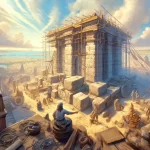
Haggai belongs to the restoration phase of redemptive history. Israel has already experienced judgment through exile, and now God is re-establishing His people in the land. The rebuilding of the temple symbolizes not merely construction but covenant restoration. The question beneath the surface is not architectural but theological: will the people once again live as the people of God?
Covenant Context
The book operates within the framework of the Mosaic Covenant. Blessings and curses tied to obedience are visibly at work. The people’s economic frustration is not accidental but covenantal discipline. Haggai interprets their circumstances as divine correction, urging them to return to covenant faithfulness through obedience and worship.
Purpose of the Book
The purpose of Haggai is to call the returned exiles to resume and complete the rebuilding of the temple. More deeply, it seeks to correct spiritual complacency and reestablish the centrality of God in the life of His people. The rebuilding of the temple becomes the visible expression of inward repentance and renewed devotion.
Key Insight: Spiritual neglect often disguises itself as practical necessity, but God exposes it as misplaced priority.
Central Message
The central message of Haggai is simple yet piercing: when God’s people prioritize themselves over God, disorder follows; when they restore God to His rightful place, blessing returns. The call to rebuild the temple is ultimately a call to rebuild devotion.
Major Themes
Priority of Worship: God’s house must come before personal comfort.
Divine Discipline: Economic hardship reflects spiritual misalignment.
Obedience and Blessing: Renewal begins with responsive obedience.
Future Glory: God promises a greater glory beyond present limitations.
Literary Genre
Haggai is prophetic literature, characterized by direct exhortation, divine speech, and historical markers. Its concise structure and dated oracles give it a precise and almost journal-like clarity, making it one of the most historically anchored prophetic books.
Literary Structure
The book is structured around four dated messages delivered over approximately four months. Each message builds upon the previous, moving from rebuke to encouragement to promise.
Structural Outline
1. Call to Rebuild the Temple (1:1–11)
2. The People Respond in Obedience (1:12–15)
3. Encouragement and Promise of Glory (2:1–9)
4. Blessing Following Obedience (2:10–19)
5. Promise to Zerubbabel (2:20–23)
Major Characters or Figures
Haggai: The prophet delivering God’s message.
Zerubbabel: Governor of Judah, representing political leadership.
Joshua: High priest, representing spiritual leadership.
Major Events
The central event is the resumption of temple construction. The people, stirred by Haggai’s preaching, move from indifference to action, demonstrating the power of prophetic confrontation and communal obedience.
Key Verses
“Consider your ways.” Haggai 1:5 (ESV)
“Go up to the hills and bring wood and build the house, that I may take pleasure in it and that I may be glorified, says the Lord.” Haggai 1:8 (ESV)
“The latter glory of this house shall be greater than the former, says the Lord of hosts.” Haggai 2:9 (ESV)
Christological Connection
Haggai’s promise of greater glory points forward to Christ. The rebuilt temple itself was modest compared to Solomon’s, yet its greater glory is fulfilled not in architecture but in the presence of Jesus Christ, who would later enter that very temple. Christ is the true temple, the ultimate meeting place between God and man.
Biblical Theology Contribution
Haggai contributes to the theme of restoration after judgment. It reinforces that God’s covenant purposes persist despite human failure. The temple motif develops toward the New Testament understanding of God dwelling among His people through Christ and the church.
Canonical Connections
Haggai connects closely with Ezra and Nehemiah in historical narrative, and with Zechariah in prophetic encouragement. It also anticipates New Testament teachings on spiritual priorities and the indwelling presence of God.
Doctrinal Significance
Divine Sovereignty: God directs history and circumstances.
Sanctification: Obedience restores alignment with God’s will.
Worship Theology: God’s presence among His people is central.
Teaching Outline for Ministry
1. Diagnose misplaced priorities
2. Call for renewed obedience
3. Encourage through God’s promises
4. Highlight future glory in Christ
Ministry Leadership Insight
Leaders must address both external challenges and internal apathy. Haggai models direct, timely, and God-centered leadership. He does not entertain excuses but redirects focus. Ministry often stalls not because of opposition but because of distraction.
Ministry and Life Application
Ministers must continually ask whether God’s work is receiving first attention or leftover energy. Churches can appear active while remaining spiritually neglected. Haggai reminds us that obedience precedes renewal, not the other way around.
Common Misinterpretations or Debates
Some interpret Haggai as a prosperity formula, suggesting obedience guarantees material success. However, the book teaches covenantal alignment, not transactional religion. Others overlook its Christological fulfillment, reducing it to historical reconstruction rather than redemptive anticipation.
Teaching Keywords
Restoration, Temple, Obedience, Priority, Covenant, Glory, Renewal
Summary Paragraph
Haggai confronts the quiet drift of God’s people with remarkable clarity. It exposes how easily devotion can be replaced with distraction and how quickly spiritual neglect reshapes an entire community. Yet it also offers hope, because God responds to obedience with renewed presence and promise. For ministers, Haggai serves as both mirror and mandate, calling leaders to restore God to the center and trust that when He is honored, everything else finds its proper place.
Sources
The Holy Bible, English Standard Version. (2016). Crossway.
Easton, M. G. (1897). Easton’s Bible Dictionary.
Vine, W. E. (1940). Vine’s Expository Dictionary of Old and New Testament Words.
Willmington, H. L. (1997). Willmington’s Guide to the Bible.
Bromiley, G. W. (Ed.). (1985). Theological Dictionary of the New Testament (Abridged).
Boyce, J. P. (1887). Abstract of Systematic Theology.