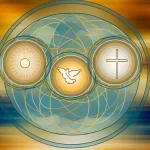
The doctrine of the Trinity stands at the heart of historic Christian confession. It affirms that the one true God eternally exists as three distinct persons, Father, Son, and Holy Spirit, who share one divine essence. This teaching does not arise from philosophical speculation, but from the progressive revelation of Scripture. The early church did not invent the Trinity; rather, it sought language that faithfully expressed what the biblical text revealed about God.
Evangelical theology insists that the Trinity safeguards both monotheism and the full deity of Christ and the Spirit. If God is not triune, the gospel itself collapses. Only a fully divine Son can accomplish redemption, and only a fully divine Spirit can apply salvation. Therefore, the doctrine is not abstract theory, but the theological foundation of worship, mission, and discipleship. This article examines its historical development, biblical grounding, theological coherence, and practical implications for the life of the church.
Trace the Historical Development of Trinitarian Doctrine
The early church inherited strict Jewish monotheism. At the same time, believers confessed Jesus as Lord and experienced the active presence of the Holy Spirit. This created theological tension that demanded careful articulation. The church’s task was not innovation, but clarification.
The Council of Nicaea in 325 AD confronted Arianism, which denied the full deity of Christ. The council affirmed that the Son is homoousios, meaning of the same substance with the Father. This preserved both distinction of persons and unity of essence.
Later, the Council of Constantinople in 381 AD addressed confusion regarding the Holy Spirit. The church affirmed that the Spirit is likewise fully divine. The Niceno Constantinopolitan Creed became a doctrinal boundary marker for orthodox Christianity.
James P. Boyce explains that the doctrine of the Trinity arises necessarily from the total testimony of Scripture and cannot be reduced without distorting divine revelation. Similarly, R. A. Torrey defends the full deity of Christ and the Spirit as essential to biblical faith. These evangelical theologians demonstrate continuity with the historic creeds while grounding their arguments in Scripture.
Examine the Biblical Foundations of the Trinity
Observe the Old Testament Witness
The Old Testament firmly proclaims the unity of God. Deuteronomy 6:4 declares, “Hear, O Israel: The Lord our God, the Lord is one.” Yet within this unity, hints of plurality emerge. Genesis 1:26 records, “Let us make man in our image.” Isaiah 48:16 portrays the Lord God and His Spirit acting together.
Theological reflection must proceed cautiously, since the Old Testament does not offer a fully developed Trinitarian formula. However, it prepares the reader for greater revelation. Boyce argues that the unity of God does not exclude personal distinctions within the divine nature. The Old Testament establishes monotheistic foundations upon which the New Testament builds.
Analyze the New Testament Revelation
The New Testament provides explicit clarity. At the baptism of Jesus in Matthew 3:16 to 17, the Son is baptized, the Spirit descends, and the Father speaks from heaven. This is not modalism, but simultaneous personal distinction.
In Matthew 28:19, Jesus commands disciples to baptize “in the name of the Father and of the Son and of the Holy Spirit.” The singular word name indicates unity, while the threefold designation indicates distinction.
John 14 to 16 presents relational language between Father, Son, and Spirit. Jesus speaks of sending another Helper, who proceeds from the Father. Torrey carefully catalogs these passages to demonstrate both equality and relational order. The New Testament does not offer philosophical abstraction; it reveals divine life through redemptive history.
Clarify the Theological Coherence of the Trinity
The doctrine may be summarized in three affirmations. First, there is one God. Second, the Father, Son, and Holy Spirit are distinct persons. Third, each person is fully God. Denying any of these leads to heresy.
Modalism collapses the persons into temporary manifestations. Arianism denies full deity to the Son. Tritheism divides the essence into three gods. Orthodox Trinitarianism avoids all three errors.
The theological term perichoresis describes the mutual indwelling of the persons. The Father is not the Son, yet the Father is fully in the Son. This eternal communion explains how God is love in His very being. Love is not created; it is eternal.
According to Vine’s Expository Dictionary, the New Testament language for Father and Son communicates genuine relational distinction, not metaphorical appearance. The doctrine therefore preserves biblical language while protecting divine unity.
Apply the Trinity to Worship, Mission, and Community
Trinitarian theology is not theoretical. It shapes the entire Christian life. Worship is directed to the Father, through the Son, in the power of the Spirit. Prayer reflects this pattern. Salvation reflects this pattern.
In mission, the church participates in the sending movement of God. The Father sends the Son. The Father and Son send the Spirit. The triune God sends the church. This outward orientation aligns with the Great Commission.
In community life, believers reflect divine relationality. The unity and diversity of the church mirrors the unity and distinction within God Himself. This guards against both authoritarianism and individualism. Leadership equips rather than dominates, because divine authority is relational, not coercive.
The Trinity also strengthens assurance. Salvation is not sustained by human effort. It is secured by the united action of Father, Son, and Spirit. The believer rests in the eternal communion of God.
Conclusion
The doctrine of the Trinity is not an optional theological refinement. It is the framework that makes sense of Scripture, salvation, and worship. From Genesis to Revelation, God reveals Himself as one in essence and three in persons. The early councils clarified this truth, yet Scripture remains its final authority.
When rightly understood, the Trinity deepens reverence and strengthens mission. It grounds the church in biblical orthodoxy while propelling it outward in evangelistic obedience. To confess the triune God is to confess the gospel itself.
How does your understanding of the triune nature of God shape the way you pray, worship, and participate in the mission of Christ?
Sources
Boyce, J. P. (1887). Abstract of Systematic Theology. Christian Classics Ethereal Library.
Torrey, R. A. (1898). What the Bible Teaches. Fleming H. Revell.
Vine, W. E. (1940). Vine’s Complete Expository Dictionary of Old and New Testament Words.