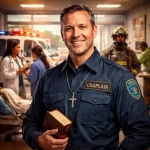
Christian chaplain role involves bringing spiritual care and guidance to people outside traditional church settings. Chaplains serve in hospitals, prisons, schools, the military, and workplaces, helping individuals find peace, hope, and faith where life pressures are greatest. This role reflects the outward movement of the Gospel, where ministry is not confined to a building but carried into the lived realities of suffering, decision making, and human limitation. In many cases, the chaplain becomes the only visible representative of Christ in environments where formal church structures are absent or inaccessible. This demands both theological clarity and pastoral sensitivity, since the chaplain must faithfully represent biblical truth while engaging individuals from diverse beliefs and backgrounds (Willmington, 1999).
Pastoral Care
Chaplains provide emotional and spiritual support through counseling, prayer, and presence. They offer comfort during grief, crisis, and recovery, helping people rediscover meaning and strength. This care is often incarnational rather than programmatic, meaning the chaplain embodies the presence of Christ through listening, empathy, and faithful presence. Unlike traditional pastoral ministry, chaplaincy frequently occurs in moments of acute vulnerability, where individuals are confronting mortality, injustice, trauma, or uncertainty. In such moments, theological precision must be joined with pastoral restraint, avoiding simplistic answers while still pointing toward eternal truth. The ministry of presence itself becomes a theological act, reflecting the nearness of God to the brokenhearted (Psalm 34:18, ESV).
Key Takeaway: Pastoral care is the heart of chaplaincy. It meets people with compassion and faith in their moments of need. It also requires discernment, knowing when to speak, when to listen, and when silence itself communicates the weight of divine compassion.
Worship Services and Spiritual Leadership
In hospitals, military bases, and correctional facilities, chaplains conduct worship services, lead Bible studies, and guide people in prayer. They create sacred spaces that foster community and reflection. These environments often lack traditional markers of worship, yet the chaplain establishes spiritual rhythm and structure where chaos or institutional routine dominates. Worship in these contexts is frequently contextualized, yet it must remain doctrinally grounded, ensuring that the message of Christ is not diluted for the sake of accessibility. Chaplains must balance inclusivity with conviction, particularly in pluralistic settings where multiple faith traditions may be present. This requires a disciplined understanding of the Gospel and a clear commitment to Christ-centered proclamation (Geisler, 1999).
Key Takeaway: Worship leadership by chaplains connects faith to real-life contexts and brings the presence of Christ into every environment. It transforms ordinary institutional spaces into places where eternal realities are acknowledged and proclaimed.
Education and Training
Chaplains teach and train individuals and groups in faith principles, ethics, and moral decision making. They help others understand how Scripture informs personal and professional life. This instructional role often intersects with institutional frameworks, such as medical ethics, military conduct, or correctional rehabilitation. The chaplain must therefore translate biblical truth into applied wisdom without compromising its authority. Education in chaplaincy is not merely informational but formational, shaping how individuals think, decide, and act under pressure. It equips people to navigate complex moral landscapes where competing values and responsibilities must be weighed carefully. In this sense, chaplains function as theological interpreters within secular systems, bringing clarity where confusion often prevails (Boyce, 1887/2006).
Key Takeaway: Education equips believers to live out faith responsibly and confidently in diverse settings. It also prepares individuals to integrate biblical conviction with real-world responsibilities without fragmenting their faith.
Advocacy and Spiritual Rights
Christian chaplains ensure that spiritual and religious needs are respected, often advocating for freedom of worship and conscience within institutions. This advocacy is not merely administrative but theological, grounded in the belief that every person bears the image of God and therefore possesses inherent dignity and spiritual capacity (Genesis 1:27, ESV). Chaplains frequently navigate institutional policies, legal frameworks, and cultural expectations to ensure that individuals are not denied access to spiritual care. This may involve facilitating religious accommodations, protecting the rights of minority faith groups, or ensuring that Christian expression is not unnecessarily restricted. The chaplain must operate with wisdom, balancing institutional compliance with faithful representation of biblical convictions.
Key Takeaway: Advocacy ensures that every person has the right to believe and worship freely, and that this right is honored and protected within structured systems. It reflects a commitment to both justice and compassion rooted in biblical anthropology.
Community Building
Chaplains foster community by connecting people through shared faith, values, and service. They nurture belonging and unity where isolation and stress are common. In many institutional environments, individuals experience fragmentation, anonymity, or relational disconnection. The chaplain works intentionally to counter this by cultivating spaces of trust, dialogue, and mutual support. Community building is not accidental but strategic, often involving small groups, informal conversations, and shared spiritual practices. It reflects the biblical vision of the body of Christ, where individuals are not meant to function in isolation but in relational interdependence (1 Corinthians 12:12-27, ESV). The chaplain becomes a catalyst for relational restoration, even in settings not explicitly designed for spiritual formation.
Key Takeaway: Community building through chaplaincy transforms workplaces and institutions into spaces of compassion and purpose. It reminds individuals that even in structured systems, authentic human connection remains both possible and necessary.
Conclusion
Overall, what does a Christian chaplain do? They minister wherever people need God’s presence, offering care, hope, and truth beyond church walls. Their calling reminds believers that God’s mission extends into every sphere of human life. More than a role, chaplaincy represents a theological posture, one that refuses to confine the Gospel to traditional spaces and instead carries it into the complexities of everyday existence. It challenges ministers to reconsider the boundaries of ministry and to recognize that the field is not limited to the sanctuary but extends into hospitals, prisons, workplaces, and beyond. In this sense, the chaplain embodies the missional nature of the Church, demonstrating that wherever people are, there the ministry of Christ must also be present.
Learn more about Christian ministry and ordination through the
References
- Bible Reference: Colossians 3:17: “Whatever you do, in word or deed, do everything in the name of the Lord Jesus.”
- Boyce, J. P. (2006). Abstract of Systematic Theology. Founders Press. (Original work published 1887)
- Geisler, N. L. (1999). Baker Encyclopedia of Christian Apologetics. Baker Academic.
- Willmington, H. L. (1999). Willmington’s Guide to the Bible. Tyndale House.