This Christian wedding ceremony outline provides a structured, biblically ordered framework for ministers conducting covenant marriage ceremonies. Below is a general outline for a Christian wedding ceremony conducted by a minister. This structure preserves biblical order, pastoral clarity, and legal integrity, while allowing room for cultural and personal expression.
1. Prelude:
Instrumental music or hymns are played as guests are seated, creating a tone of reverence rather than mere celebration.
The atmosphere is intentionally set to reflect that this gathering is not simply a social event, but a covenant ceremony before God and witnesses.
2. Processional:
The wedding party, including the groomsmen, bridesmaids, ring bearer, and flower girl, enter the venue in a designated order, symbolizing preparation and support for the couple.
The bride, escorted by her father or a chosen representative, walks down the aisle as a visible moment of honor, transition, and joyful anticipation.
3. Welcome and Introduction:
The minister welcomes the guests and formally begins the ceremony.
A brief acknowledgment of the sacredness of marriage is offered, clarifying that this union is established under God’s design and authority.
4. Opening Prayer:
A prayer invites God’s presence, wisdom, and blessing upon the ceremony and the covenant being formed.
The focus is placed on dependence upon the Lord rather than human emotion alone.
5. Scripture Reading:
Selections from Scripture highlight love, covenant faithfulness, and God’s design for marriage.
Common passages include 1 Corinthians 13:4-7, Ephesians 5:22-33, Genesis 2:18-24, or Colossians 3:12-14.
6. Charge to the Couple:
The minister addresses the couple directly, reminding them that marriage is a covenant of lifelong fidelity, not a temporary agreement of convenience.
The charge encourages mutual honor, sacrificial love, forgiveness, spiritual leadership, and shared devotion to Christ.
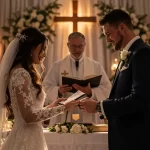
7. Exchange of Vows:
The couple faces one another and expresses vows of faithfulness, promising steadfast love in prosperity and hardship alike.
Vows may follow a traditional format or include carefully prepared personal commitments, provided they uphold biblical permanence.
8. Exchange of Rings:
The couple exchanges wedding rings as visible symbols of unity, covenant loyalty, and enduring commitment.
The minister may briefly explain that the unbroken circle represents the intention of lifelong faithfulness.
9. Declaration of Marriage:
Upon the exchange of vows and rings, the minister declares the couple husband and wife before God and assembled witnesses.
This declaration affirms both spiritual covenant and, where applicable, legal recognition.
10. Blessing of the Marriage:
A pastoral prayer asks for God’s sustaining grace in the couple’s shared life.
Requests are made for wisdom in decision making, resilience in adversity, joy in companionship, and faithfulness across the years.
11. Pronouncement and Kiss:
The minister pronounces the couple husband and wife, completing the covenant ceremony.
The couple seals their vows with a kiss as a public sign of their newly formed marital union.
12. Presentation of the Couple:
The minister introduces the newly married couple to the congregation, commonly as “Mr. and Mrs. [Last Name]” or according to their chosen presentation.
The gathered witnesses respond with applause and celebration.
13. Recessional:
The couple exits together, followed by the wedding party, to a recessional song that marks the joyful conclusion of the ceremony.
Guests are then dismissed or directed toward the reception.
Please note that this Christian wedding ceremony outline provides a structured framework for a Christian wedding ceremony. It may be adapted according to the couple’s preferences, cultural traditions, local legal requirements, and the doctrinal guidelines of the officiating minister’s church or denomination. The essential components remain covenant vows before God, public witness, pastoral blessing, and lawful solemnization.
Frequently Asked Questions About a Christian Wedding Ceremony Outline
What is a Christian wedding ceremony outline?
A Christian wedding ceremony outline is a structured order of service that guides ministers through biblically grounded covenant vows, public witness, pastoral blessing, and lawful solemnization.
Is a Christian wedding ceremony outline legally binding?
The outline itself is not legal documentation, but it supports lawful solemnization when combined with proper licensing, authorized officiation, and signed marriage documentation.
Can ministers modify a Christian wedding ceremony outline?
Yes. Ministers may adapt cultural elements and personal expressions, provided biblical covenant permanence and legal integrity remain intact.
Why is Scripture included in a Christian wedding ceremony outline?
Scripture establishes marriage as a covenant before God and provides theological grounding for vows, sacrificial love, and lifelong fidelity.
What are the essential elements of a Christian wedding ceremony outline?
The essential elements include covenant vows before God, exchange of rings, public declaration, pastoral blessing, and legal solemnization.