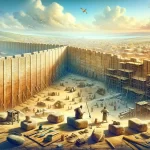
Ezra: The Return and Restoration of God’s People
One Sentence Memory Line
The book of Ezra records how God faithfully restored His people from exile, rebuilt the temple in Jerusalem, and renewed covenant obedience through the leadership of Ezra the scribe.
Historical Setting
The events of Ezra take place after the Babylonian exile, during the period when the Persian Empire ruled the ancient Near East. In 539 BC, the Persian king Cyrus conquered Babylon and issued a decree allowing Jewish exiles to return to their homeland and rebuild the temple in Jerusalem. This moment marked a major turning point in Israel’s history because it signaled the beginning of restoration after decades of judgment and displacement.
The narrative of Ezra spans roughly eighty years, beginning around 538 BC with the first return of exiles under Zerubbabel and concluding with Ezra’s reforms around 458 BC. During this time, the Jewish community faced both external opposition and internal spiritual struggles. The rebuilding of the temple, completed in 516 BC, became the central symbol of renewed worship and covenant identity.
Canonical Placement
Ezra appears in the historical books of the Old Testament, following 2 Chronicles and preceding Nehemiah. In the Hebrew Bible, Ezra and Nehemiah were originally treated as a single combined narrative describing the restoration of the Jewish community after exile. Together they tell the story of rebuilding the temple, restoring the law, and reconstructing the walls of Jerusalem.
Redemptive History Placement
Ezra belongs to the postexilic period of Israel’s history. The exile had occurred because of Israel’s persistent covenant unfaithfulness. Yet God had promised through the prophets that restoration would come. Ezra demonstrates that God’s covenant promises remained intact even after severe judgment. The return from exile reveals God’s mercy and His commitment to preserve a people through whom the Messiah would eventually come.
Covenant Context
The narrative unfolds within the framework of the Mosaic covenant. The exile had confirmed the warnings given in Deuteronomy that disobedience would lead to national judgment. The restoration, however, reflected God’s faithfulness to His covenant promises. Ezra’s ministry particularly emphasizes the restoration of obedience to the Law of Moses, which was central to Israel’s identity as the covenant people of God.
Key Insight: The book of Ezra demonstrates that spiritual restoration always begins with renewed devotion to God’s Word and faithful worship centered on God’s presence.
Purpose of the Book
The purpose of Ezra is to record how God restored the Jewish community after exile and reestablished proper worship through the rebuilding of the temple and the renewal of obedience to God’s law. The book also highlights God’s providence in moving the hearts of foreign kings to accomplish His purposes.
Central Message
God faithfully restores His people when they return to Him with repentance, renewed obedience, and reverence for His Word.
Major Themes
Several theological themes dominate the book. One central theme is restoration after judgment. Despite Israel’s exile, God preserved a remnant and brought them back to their homeland. Another theme is the importance of worship. The rebuilding of the temple restored the center of Israel’s spiritual life.
A third theme is the authority of Scripture. Ezra himself was known as a skilled scribe devoted to studying and teaching the law of the Lord. The book also emphasizes God’s sovereign providence, as Persian kings repeatedly support the rebuilding effort.
Literary Genre
Ezra is a historical narrative containing official documents, royal decrees, genealogies, and personal memoirs. Portions of the book include Aramaic administrative correspondence preserved from Persian records.
Literary Structure
The book is divided into two major movements. The first section focuses on the return under Zerubbabel and the rebuilding of the temple. The second section centers on Ezra’s arrival and the spiritual reforms he initiated among the returned exiles.
Structural Outline
- Return of the exiles under Zerubbabel (Chapters 1–2)
- Rebuilding the altar and temple foundation (Chapter 3)
- Opposition and delays in construction (Chapters 4–6)
- Completion and dedication of the temple (Chapter 6)
- Ezra’s return to Jerusalem (Chapter 7–8)
- Spiritual reform and repentance (Chapters 9–10)
Major Characters or Figures
Zerubbabel led the first group of returning exiles and supervised the rebuilding of the temple.
Ezra served as a priest and scribe devoted to teaching the law of the Lord.
Cyrus the Great issued the decree permitting the Jewish return.
Darius and Artaxerxes later supported the restoration project through official decrees.
Major Events
The key events include the decree of Cyrus permitting the return, the rebuilding of the altar, the laying of the temple foundation, opposition from surrounding peoples, the completion of the temple, and Ezra’s call for national repentance regarding intermarriage with pagan nations.
Key Verses
Ezra 1:3 (ESV)
“Whoever is among you of all his people, may his God be with him, and let him go up to Jerusalem, which is in Judah, and rebuild the house of the Lord, the God of Israel.”
Ezra 7:10 (ESV)
“For Ezra had set his heart to study the Law of the Lord, and to do it and to teach his statutes and rules in Israel.”
Christological Connection
The rebuilding of the temple anticipates the coming of Jesus Christ, who later declared Himself to be the true temple of God (John 2:19–21). The restored temple also prepared the setting for the future ministry of Christ in Jerusalem. Ezra’s emphasis on the authority of God’s Word likewise foreshadows the ministry of Christ as the ultimate teacher and fulfillment of the law.
Biblical Theology Contribution
Ezra contributes to biblical theology by demonstrating that God preserves a covenant people even after judgment. The restoration of Israel after exile ensures the continuation of the redemptive line leading to the Messiah.
Canonical Connections
Ezra connects closely with the books of Haggai and Zechariah, whose prophetic ministries encouraged the rebuilding of the temple. It also parallels Nehemiah, which describes the rebuilding of Jerusalem’s walls and further spiritual reform.
Doctrinal Significance
The book reinforces doctrines such as divine providence, covenant faithfulness, and the centrality of worship. It also highlights the authority of Scripture and the need for repentance and spiritual renewal among God’s people.
Teaching Outline for Ministry
- God initiates restoration.
- True worship must be rebuilt.
- Opposition accompanies obedience.
- Scripture shapes the life of God’s people.
- Repentance leads to renewal.
Ministry Leadership Insight
Ezra offers a model of leadership centered on Scripture. His commitment to study, obey, and teach the Word of God provides a powerful example for pastors and ministry leaders today.
Ministry Application
Church leaders today can learn from Ezra that rebuilding spiritual life requires commitment to God’s Word, courageous leadership, and willingness to call people back to faithful obedience.
Common Misinterpretations or Debates
One debated issue concerns Ezra’s response to intermarriage. Some readers misunderstand the reform as ethnic discrimination. In context, however, the concern was covenant faithfulness. Intermarriage with pagan nations often led Israel into idolatry, which threatened the spiritual identity of the restored community.
Teaching Keywords
Exile, restoration, temple rebuilding, covenant renewal, Persian decree, Ezra the scribe, spiritual reform, divine providence.
Summary Paragraph
The book of Ezra records one of the most hopeful chapters in Israel’s history. After years of exile and judgment, God restored His people to their land and renewed their worship through the rebuilding of the temple. Through the leadership of Zerubbabel and Ezra, the community rediscovered the central role of God’s Word and the necessity of covenant faithfulness. For ministers today, Ezra reminds us that spiritual restoration always begins with reverence for God’s presence and obedience to His Word.
Sources
Boyce, J. P. (1887). Abstract of Systematic Theology. American Baptist Publication Society.
Boyd, G., & Eddy, P. (2009). Across the Spectrum: Understanding Issues in Evangelical Theology. Baker Academic.
Easton, M. (1897). Easton’s Bible Dictionary. Harper & Brothers.
The Holy Bible, English Standard Version. (2016). Crossway.
Willmington, H. (1999). Willmington’s Guide to the Bible. Tyndale House.